If your nonprofit wants to grow foundation funding, one of the first questions is often: Which foundation database should we use?
Candid Foundation Directory, Instrumentl, GrantStation, Grants.gov and other resources can help nonprofits identify funding opportunities. Some provide deep information about foundations and their historical giving. Others focus more on finding open opportunities, matching organizations with funders or managing the grant process.
So which one is best?
The answer depends less on which platform has the most data and more on what your organization needs to accomplish with that data. Before investing in another platform, there is an even more important question to answer:
Is finding foundations actually the problem?
It is easy to think of foundation databases as interchangeable, but different platforms are designed to solve different problems.
If your primary need is researching private foundations, their giving history, past grantees and funding interests, a research-focused platform such as Candid Foundation Directory may make sense. If you want to discover grant opportunities while also organizing prospecting, deadlines and grant activity, a platform such as Instrumentl may be a better fit.
GrantStation is another option for identifying potential funding opportunities, while Grants.gov should be part of the research process for organizations pursuing federal funding. There are also free resources, including IRS nonprofit data and ProPublica's Nonprofit Explorer, that can be valuable for reviewing Form 990 filings and researching foundations without immediately adding another paid subscription.
The question isn't simply “Which database is best?” It's “Which database is best for what we're trying to accomplish?”
Candid Foundation Directory is one of the best-known tools for researching foundations and institutional funders. Its strength is the depth of information available for understanding potential funders, including giving interests, past grants and historical grantees.
It can be particularly useful when your organization wants to conduct deeper prospect research rather than simply search for currently advertised grant opportunities. For nonprofits building a serious foundation prospecting program, understanding who a foundation has actually funded can be much more valuable than simply finding a foundation whose stated interests appear to match your mission.
Instrumentl combines funder discovery with tools designed to help nonprofits manage more of the grant process. That can make it attractive to organizations that want a platform to help identify opportunities, track prospects and deadlines, and manage grant activity in one place.
For a smaller development team without a well-established grant workflow, having research and workflow functionality together may be particularly useful. An organization primarily looking for deep foundation intelligence, however, may evaluate the platform differently from one primarily looking for grant discovery and workflow management.
GrantStation provides another way for nonprofits to identify potential funding opportunities from foundations, corporate giving programs and other sources. It may be a good fit for organizations that want a grant research resource without necessarily needing a larger prospect-intelligence or fundraising technology ecosystem.
As with any platform, the value depends heavily on how consistently the organization uses the information it finds.
For nonprofits pursuing federal grants, Grants.gov is an important resource. But federal grant prospecting is different from foundation prospecting. Federal opportunities often have highly specific eligibility requirements, application processes, compliance requirements and timelines.
Organizations should therefore think about government funding and private foundation fundraising as related but distinct strategies rather than expecting one directory to solve both.
Not every nonprofit needs to begin with an expensive subscription.
IRS Form 990 filings can reveal valuable information about a foundation's assets, officers, giving and grant history. ProPublica's Nonprofit Explorer makes much of this information easier to access and search. Foundation websites, annual reports, published grantee lists, LinkedIn and general web research can add another layer of intelligence.
For an organization making its first few foundation approaches, these resources may be enough to begin building a prospect list before investing in a more sophisticated platform. But as the number of prospects grows, the time required to manually research and organize all of this information grows with it. That's when technology can become increasingly valuable.
This is where the foundation database conversation often goes wrong.
A powerful database can give your organization hundreds or even thousands of potential funders. That doesn't mean your development team should pursue hundreds or thousands of foundations.
The objective isn't to build the biggest list. It's to identify the funders where your organization has the strongest opportunity for alignment and funding.
Imagine two organizations. One exports 500 foundation names from a database and begins sending generic outreach. The other identifies 40 highly relevant foundations, studies their giving history, determines why each might care about the organization's work, prioritizes them, develops an approach and consistently follows up.
The second organization may have the smaller database and the much stronger foundation fundraising program.
Finding prospects is only the beginning.
A productive foundation fundraising process looks more like:
Research → Qualification → Prioritization → Engagement → Relationship Building → LOI/Proposal → Follow-Up → Stewardship → Learning
A database primarily helps with the beginning of that process. The rest requires strategy, people, content, processes, data and consistent execution.
For every serious foundation prospect, your organization should be able to answer questions such as:
A list of foundation names doesn't answer those questions. A foundation fundraising system does.
Not every potential funder deserves the same amount of your team's time. A simple foundation-fit framework can help.
Mission Fit: How closely does the foundation's giving align with your mission?
Program Fit: Has it funded programs similar to the one for which you are seeking support?
Geographic Fit: Does it regularly fund organizations or programs in your service area?
Giving History: What does its actual grantmaking tell you about its priorities?
Grant Size: Are its typical grants appropriate for the amount you are seeking?
Accessibility: Does it accept applications or inquiries from organizations without an existing relationship?
Relationship Potential: Does anyone connected to your organization have a path to the foundation, its leadership or its network?
These factors can be used to rank prospects rather than treating every database result equally. A foundation with a perfect keyword match but no geographic alignment may deserve less attention than a foundation whose actual giving history demonstrates a strong connection to your work.
The goal is not more prospects. The goal is better prospects.
Identifying the right foundations is only part of the opportunity.
Foundations are made up of people. Those people research, evaluate and form opinions about the organizations they may fund. Once you identify a high-priority foundation, the next questions should be: Who are the people involved in funding decisions? What matters to them? What do they need to understand about your organization? And what will they experience when they encounter you?
A program officer may visit your website after receiving an introduction. A board member may see a post from your CEO on LinkedIn. A foundation executive may search for your organization or ask an AI tool about your work. Someone may attend an event, read an impact story, watch a program video or receive a briefing from a mutual connection.
Each interaction helps shape that person's understanding of your organization.
That means foundation development isn't only about creating a strong proposal. It is also about creating the content and experiences that make your organization easier to understand, trust and remember.
For your highest-priority foundation audiences, think about what they should encounter before, during and after direct outreach. That might include clear program pages, compelling impact stories, credible outcomes and data, leadership perspectives, relevant research, short videos, case studies, annual reports, personalized briefing materials or opportunities to experience the work firsthand.
The objective isn't to bombard foundation staff with marketing. It is to make sure that when the right person becomes interested in your organization, there is a consistent and compelling body of evidence supporting the relationship.
Don't just build a foundation prospect list. Build an experience around the people you most want to know your organization.
A stronger foundation strategy connects these activities rather than treating prospect research, communications and grant writing as separate functions.
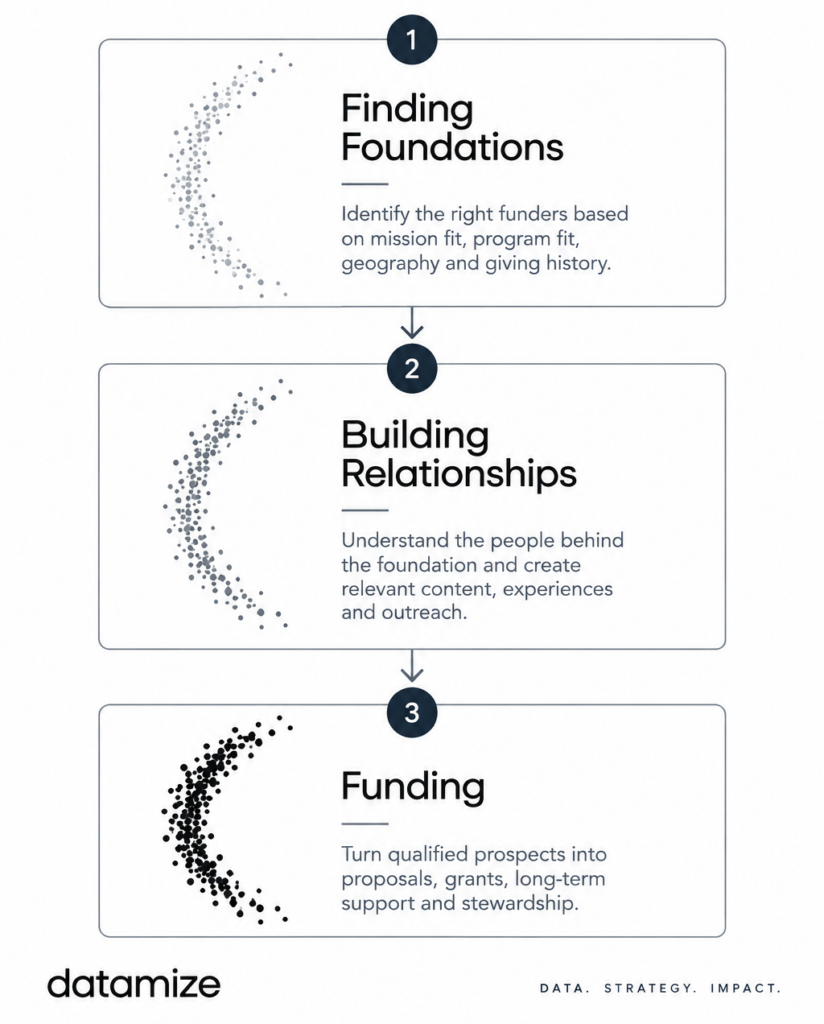
This is where foundation fundraising becomes much more than searching a database and submitting applications. The goal is to build a system that helps the right people discover your organization, understand its work, develop confidence in its impact and ultimately build a relationship with it.
For a high-value foundation prospect, consider the experience from that person's perspective:
Awareness → Discovery → Understanding → Trust → Engagement → Relationship → Funding → Stewardship
At each stage, ask what information or experience would help move the relationship forward.
During discovery, that may be a strong website and a clear explanation of the problem your organization solves. During understanding, it may be program information, outcomes, financial credibility and evidence of impact. During trust building, it may be leadership content, third-party validation, stories from the people you serve or a conversation with program leadership.
During engagement, it might be an invitation to visit a program, attend an event, participate in a briefing or meet the people doing the work. After funding, the experience matters just as much. Personalized updates, meaningful impact reporting and opportunities to see what their investment accomplished can help turn a grant into a long-term funding relationship.
The strongest foundation programs therefore don't simply maintain a list of prospects and deadlines. They deliberately build relationships, content and experiences around the people most important to their growth.
This is another common problem.
A nonprofit researches foundations and eventually creates an Excel spreadsheet containing hundreds of prospects. Someone updates it. Someone else creates another version. Applications are tracked in email. Deadlines live on calendars. Relationship notes live in someone's head. Award history is somewhere else.
Over time, valuable institutional knowledge becomes fragmented.
As a foundation fundraising program grows, qualified prospects should move into a structured system where the organization can track:
Foundation → Fit → Key People → Relationships → Program → Opportunity → Engagement → Next Action → Deadline → Stage → Requested Amount → Awarded Amount
Leadership should then be able to answer important questions quickly. How much foundation funding are we pursuing? How much have we requested? What is currently in the pipeline? Which prospects need follow-up? Which relationships are getting stronger? Which programs are attracting the most interest? What percentage of proposals are being funded? Which funders should we cultivate for larger or renewed support?
That is when foundation research begins becoming a repeatable growth system rather than a series of individual grant applications.
AI adds another layer to this process, but the opportunity isn't simply asking ChatGPT or another AI tool to write a grant proposal.
AI can help organizations turn large amounts of funder information into usable intelligence. An organization can combine information about a foundation's historical giving with its own programs, geography, funding needs, relationships and previous interactions to help evaluate fit, summarize research, compare prospects, identify patterns, prioritize opportunities, prepare briefing documents, develop relevant content ideas, personalize outreach, surface potential connections and recommend next actions.
A foundation database provides data. The bigger opportunity is turning that data into better decisions, stronger relationships and action.
Human judgment still matters enormously, particularly when evaluating fit, building relationships and developing compelling funding strategies. But AI can reduce the amount of time skilled fundraising professionals spend gathering and organizing information so they can spend more time developing relationships and securing support.
There isn't one answer for every nonprofit.
If you're just beginning foundation fundraising, start by defining your funding priorities, programs and ideal funder profile. Free research tools may be sufficient while you develop your process.
If you're actively building a larger foundation prospect pipeline, investing in a platform such as Candid Foundation Directory, Instrumentl or GrantStation may save significant research time and help uncover opportunities you would otherwise miss.
If you have an established institutional giving program, the bigger opportunity may no longer be finding another database. It may be connecting external funder intelligence with your CRM, historical fundraising results, relationships, content, digital experiences and internal data so your team can make better decisions about where to focus and how to engage.
Before purchasing any platform, ask:
Do we need more foundation data, or do we need a better system for turning foundation data into funding?
The answer may change what you invest in next.
The best database is the one that helps your organization find the right opportunities and then act on them.
Technology can make prospecting dramatically easier. But sustainable foundation growth still requires disciplined research, qualification, prioritization, relevant content and experiences, relationship building, strong proposals, consistent follow-up, stewardship and the ability to learn from results.
Datamize helps nonprofits connect those pieces. From foundation research and prospect prioritization to identifying key people, developing content and engagement strategies, managing the pipeline, improving data and technology, strengthening outreach and proposals, and supporting ongoing execution, we help organizations build a more systematic approach to growing institutional support.
Looking to grow foundation funding? Talk to Datamize about where the biggest opportunity is in your current foundation fundraising program.
Your team is at capacity. Before you hire, find out what's actually holding growth back
It's one of the most common conversations inside growing companies and nonprofits. The fundraising team is stretched thin. Marketing has more on its plate than it can handle. Reports take too long to prepare, leadership is waiting on information, and important initiatives keep sliding to next quarter. Everyone can see the opportunities. Nobody has time to pursue them.
At that point, hiring feels like the obvious answer. Sometimes it is. But an overloaded team doesn't always mean you have a staffing problem. Just as often, it means your organization has reached the limits of the way it currently operates. Before you write the job description, it's worth figuring out what's actually constraining growth.
A team can be extremely busy without being focused on the work that matters most. More campaigns, more meetings, more reports, and more tools don't automatically produce more revenue or impact.
So start with the outcome. What are you actually trying to grow? Revenue, donors, retention, program participation, awareness? Once that's clear, ask which of your current activities genuinely contribute to it. In our experience, capacity problems often begin when too many things have quietly become priorities. Before adding resources, make sure the resources you already have are pointed at the right opportunities.
As organizations grow, their processes grow with them. More approvals, more spreadsheets, more handoffs, more people touching the same piece of work. Something that was simple with five employees can become surprisingly complicated with twenty.
Here's a useful test: if you added another person tomorrow but changed nothing about how the work gets done, would the problem actually go away? If the honest answer is no, a new hire just becomes one more person inside an inefficient process. Sometimes the better investment is simplifying the process itself.
A surprising amount of organizational capacity gets lost searching for, preparing, and reconciling information. Marketing has one number, finance has another, and the CRM says something different. Leadership asks for a report and three people spend an afternoon assembling it. A fundraiser digs through multiple systems just to understand one donor.
When data is disconnected, people become the integration layer, and that's an expensive way to move information around. Your team should be using data to make decisions and take action, not spending its days finding and assembling it. Better infrastructure, integrations, and reporting can create real capacity while helping the whole organization make smarter decisions.
Most organizations already have plenty of technology. The real question is whether any of it works together. Your CRM, website, marketing platforms, fundraising systems, and finance data should be making work easier. Too often, people end up shuttling information between them by hand.
This is where integration, automation, and increasingly AI can make a meaningful difference. Routine system updates can happen automatically. Reports can refresh without someone rebuilding them each month. AI can research prospects, analyze information, prepare drafts, summarize meetings, and surface opportunities, and trained AI agents can now handle defined pieces of work across connected systems.
The goal isn't to use AI because AI exists. The goal is to put the right technology in the right places so friction disappears and people can accomplish more.
This distinction matters more than most hiring conversations acknowledge. An organization will say "we need another marketing person," but the actual needs might include better analytics, CRM expertise, website improvements, digital advertising, content, automation, data integration, campaign strategy, and project management. One new employee is unlikely to be excellent at all of those things. The same is true in fundraising, sales, and operations.
Sometimes what an organization needs isn't another generalist. It's access to several specialized capabilities that can work together around the same growth objective. That could mean hiring, developing the existing team, bringing in outside expertise, or some combination of all three.
There's one more bottleneck that strategy alone can't solve: execution. Many organizations already know what they should be doing. The website needs work. The donor data should be segmented. The CRM needs cleanup. Leadership needs better dashboards. Automation could eliminate hours of repetitive work. The problem is that nobody has the bandwidth to actually make any of it happen.
That's a real resource problem, and it deserves a real solution.
When your team hits capacity, work through the problem in this order: outcome, priorities, process, data, technology, capabilities, and then people.
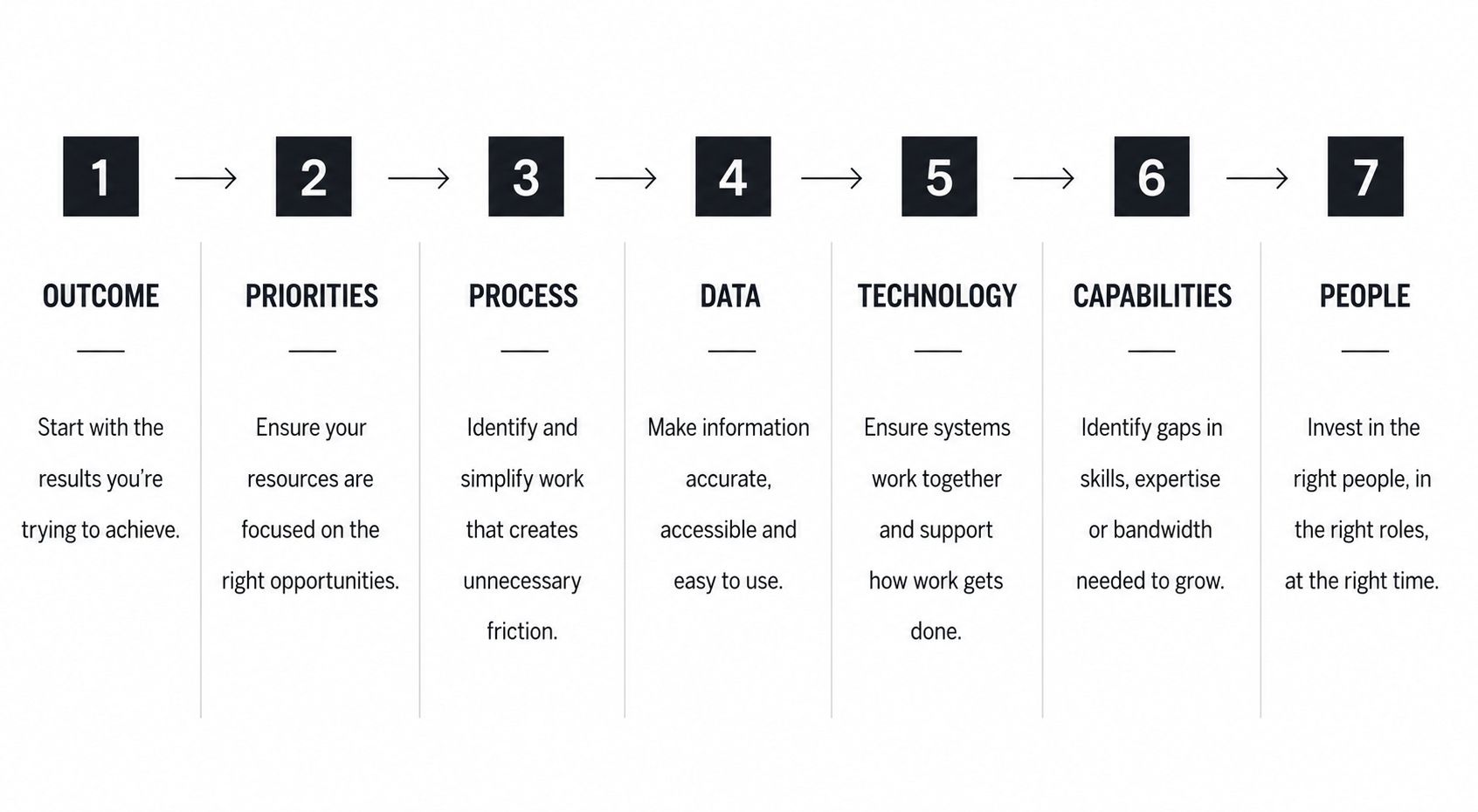
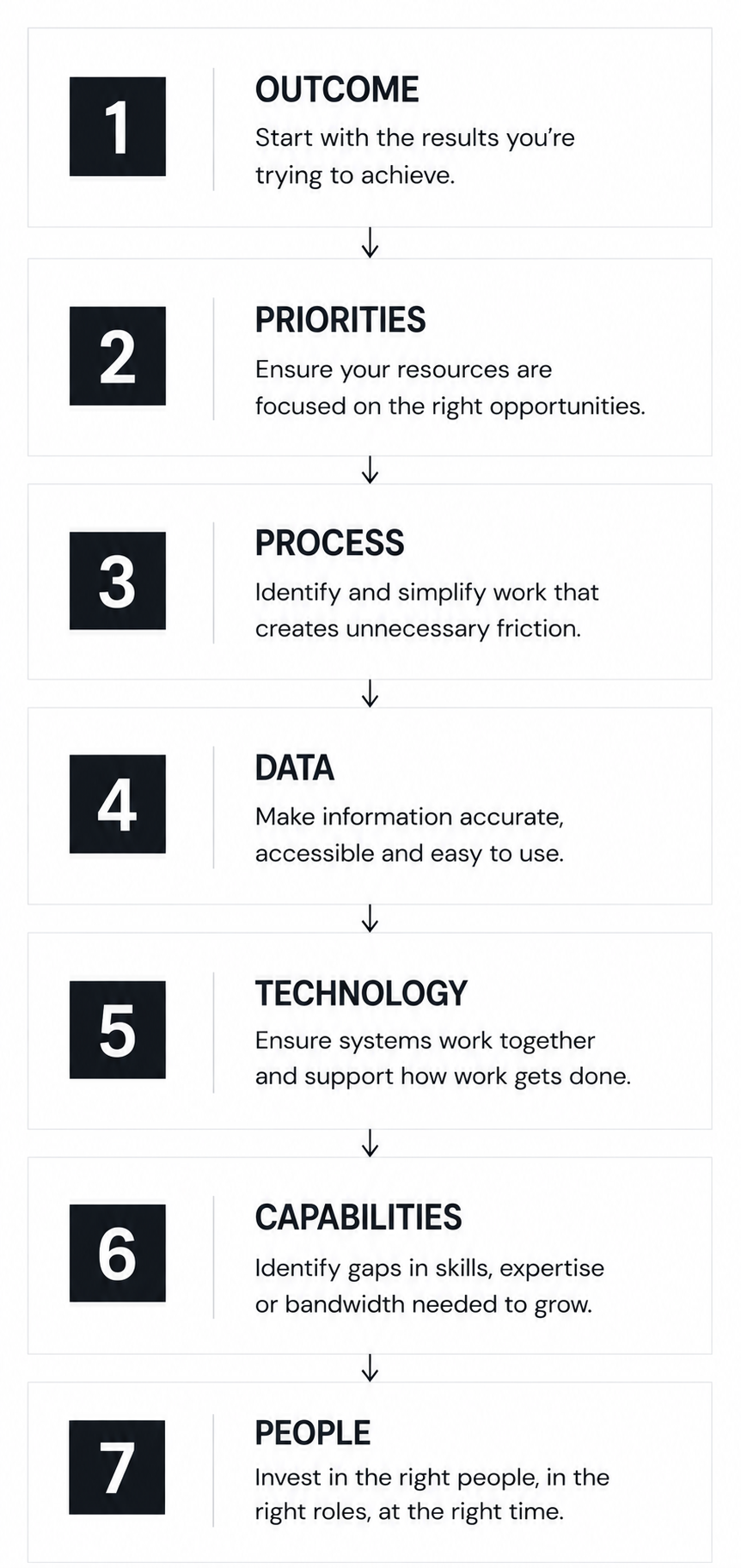
Start with the result you're trying to achieve and make sure your resources are focused on the priorities most likely to move it. Simplify unnecessary process. Make information easier to access and use. Confirm your technology is helping rather than adding work. Identify the capabilities you're missing. Then, and only then, decide where additional people are actually needed.
You may need another great employee. You may need to redesign a process, connect systems that are operating in silos, or bring in expertise you don't need to employ full time. You may simply need more execution capacity. The important thing is not to assume the answer before you understand the problem, because growth rarely comes from adding more of everything. It comes from putting the right people, data, and technology to work in the right places, around the right outcomes, and then executing.
Datamize works with companies and nonprofits to identify what's limiting growth and then help fix it. That can include growth and fundraising strategy, data and business intelligence, CRM and technology, websites and digital experiences, marketing and communications, AI and automation, and hands-on execution. Instead of looking at each piece in isolation, we connect people, data, technology, and execution around the outcomes that matter.
Is your team at capacity, or getting ready to post another position? Talk to Datamize before deciding where the next investment should go.
Cause partnering, the collaboration between for-profit and nonprofit organizations, brings together shared values for mutual growth and societal good. When done right this strategic alignment between a company’s mission and a social cause creates impactful experiences that resonate deeply with people.
Cause partnering is a multifaceted strategy that not only enhances the brand and fosters loyalty but also opens doors to new customer bases among nonprofit donors. These generous donors are also consumers - they are driven by their passions and are more likely to support businesses that don't just have great products and services but also share their commitment to making a difference, creating a win-win scenario for commerce and community.

To see how others are strategically partnering with great causes to grow revenue and make a positive impact in their communities and beyond - book a meeting here.
Are you looking for an effective way to connect with your audience and boost your organization's impact and revenue? Have you considered utilizing video as a tool to do just that? Look no further, because Datamize is here to help.
At Datamize, we understand the power of video and how it can be used to effectively communicate your message to your audience. That's why we're offering a FREE 15-minute call with our team of video experts to help you get started.
During this call, we'll discuss how to create videos that capture your organization's story and message. We'll also provide you with valuable tips on how to effectively distribute your videos through various channels to reach your target audience.
We understand that your time and resources are valuable, and that's why we're committed to providing you with the best possible advice to get the most out of your video efforts. Whether you're looking to increase awareness and donor loyalty to your nonprofit or boost sales for your business, we'll provide you with the tools and knowledge to help you succeed.
So don't hesitate, book your FREE 15-minute call with Datamize today and take the first step towards creating impactful videos for your organization. Let's work together to achieve your goals and make a difference in the world!
Facebook currently boasts 2.93 billion monthly active users.
Don't miss this opportunity to increase your funding...
As a nonprofit organization, you have the potential to raise additional funds without incurring significant expenses or overhead costs.
By doing so, you can amplify your positive impact.
Transform your followers into fundraisers, donors, and advocates for your cause.
Take this immediate step to engage your audience:
Develop captivating images/videos and powerful stories for your website's homepage.
Select key elements to feature on your Facebook page's cover photo and compose a compelling message for the "About" section. Ensure that the cover photo and "About" section complement each other to encourage users to take action.
This is crucial because your cover photo and "About" section are automatically displayed when people create Facebook fundraisers on behalf of your nonprofit.
When supporters feel good about contributing to your cause, they'll be more likely to raise funds during their birthdays and other life events, as well as participate in enjoyable challenges.
However, it's essential to simplify the process for them.
I've observed this approach working consistently for various nonprofits. Here's one example:
The following figures represent the additional funds raised through direct Facebook fundraisers for a nonprofit we've assisted over the last few years.
Although this particular nonprofit has a relatively small follower base compared to others, we equip their followers with the necessary tools to feel good about fundraising and make it effortless. Consequently, these supporters do more than just follow.
Remember that they began with no direct funds raised through Facebook for over a decade...
This extra funding significantly aids their cause, without requiring additional effort on their part. Supporters raise funds and advocate for the nonprofit because they feel good about doing so and have access to the appropriate tools that make it easy for them.
Moreover, this only accounts for direct Facebook donations.
The overall impact extends far beyond the $90k+ raised annually.
These figures don't include the indirect fundraising dollars and advocacy effects on other channels and mediums – such as direct mail, TV, email, websites, events, and one-on-one major donor/sponsor meetings – influenced by social fundraisers and advocates. I will discuss the broader impact at a later date.
I understand that these other channels and mediums are highly effective, so why not optimize their collective performance by empowering supporters where they spend their time and share content?
P.S. We are currently enhancing this approach by integrating an online-offline social conversation-to-conversion process...
This system will establish a deeper one-on-one connection between fundraisers acquired through Facebook and key individuals at the nonprofit, utilizing their CRM.
More details on this development will be provided later.
This advancement will enable nonprofits to raise even more funds, more efficiently, and generate an even greater impact.
We just saved a few clients over $127,000 this week - just by making them aware and helping them enroll in these free upcoming USPS promotions.
They would have missed out on all these postage savings because their direct mail agencies and/or the company managing their print did not fill them in.
So If you work with a direct mail provider ask them to make sure you are enrolled to get the USPS discounts.
Or you can just enroll directly with the USPS...
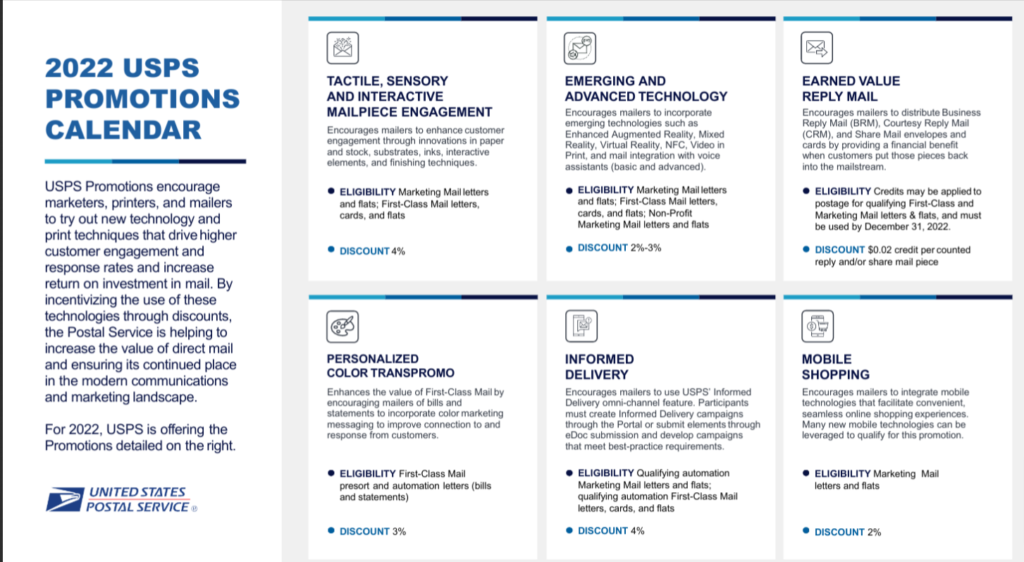
See our business development manager Slava's video here...
Say hello through the live chat at the bottom right if you need some help.
Or email us at strategy@datamize.ai if easier.
We are here for you.
Google makes $120,000 per year of free paid search ad spend available for your 501c3 nonprofit through their Google Ad Grants program.
Or if you are grandfathered into a Google GrantsPro ad account that is up to $480,000 of free ad spend per year.
Once your nonprofit is approved they break it down into a daily spend cap of $330 per day for Google Grants and $1,330 per day for Google GrantsPro.
But if you don’t capture the free spend each day, you lose it for that day.
So how do you capture as much of that $120k-$480k per year in free ad spend but also keep traffic from the people clicking through to your site targeted?
One very effective way is to use the Google Keyword Planner Tool to find keywords relevant to your nonprofit that will attract people who will support your mission. You can see the average number of monthly search forecasts for all those keywords with this tool also.
So use it to find the relevant keywords with consistent monthly search volumes and build custom landing page experiences that align with those searches.
This way when they click to your website they convert into subscribers, app downloads, and donors for your nonprofit.
Google has been making this free ad grant spend available since 2003 but most NPOs aren't getting the value out of it they could be. And many still haven’t applied to get the free ad spend.
If you are a nonprofit and want some help, Samira from our team will show you how to do this for free. Just hit the live chat button at the bottom right and we will get you set up. 😊
You can turn any web page into a QR code from your phone with just a few clicks.
And then you can easily share it.
It’s now built into the latest version of Google Chrome.
I recorded myself creating one from my iPhone screen so you can see how here...
QR codes have become so valuable for companies and nonprofits to provide great marketing, sales, and fundraising experiences for people.
So it’s cool to see Chrome has made it even easier to do...even from your phone without having to go to a QR generator website.
I expect Progressive Web Apps (PWAs) to continue to increase in use. And for more companies and nonprofits to get on board.
They are lightweight, user-friendly, personalized, and can be installed on your iPhone or Android.
So you can be right on people’s phones next to all their native apps for convenient and fast access...
to keep them thinking of you.
Many times you don't need all the features of native apps.
Clean and easy can be better for your users...and they are less expensive than native apps to develop and maintain.
I learned about PWAs a year ago from Steve Albers (from the United States Digital Service) who presented our MeetUp in Maryland at TEKsystems office.
And after seeing Steve’s impressive presentation, our team did more research and testing. Then we started making PWAs for our clients.
I personally love the idea of not being forced to go to the Apple App Store or Google Play to download to your phone.
But if you want you can publish your PWA in the Google Play app store and Microsoft app store. As those two big players are letting people choose. I applaud that move. I am waiting on Apple to open this up too. Let's make that happen. If enough people want it to happen...it will.
But a reminder, you don’t need to put your PWA in the app store anyway because people can install them on their iPhone or Android without going there or to any app marketplace.
PWAs have been around for many years. Sometimes things take time to become noticed and improved before being widely accepted and used.
I am not saying you have to abandon your native apps, you can have both if needed.
But I would recommend you start creating your PWA user experience now so you stay ahead...
Google now even includes PWAs in their Lighthouse reports...
And there is a PWA Summit today and tomorrow (October 6 and 7) that is organized by Google, Microsoft, Samsung, and Intel.
They are becoming a part of our Datamize client’s data intelligence, technology, digital marketing, and experience programs...for both companies and nonprofits.
Check out the “how to download on your iPhone” video showing a PWA that our Datamize team recently created for our client Elite Jets.
Elite Jets is a modern and growing private jet charter company with its own fleet and private terminal in Naples, Florida. Their PWA is for their customers only. So if you want to use it to get a personalized experience you have to book a flight on one of their jets. And if you want to buy me a flight...that’s cool too.
And for you nonprofit leaders, here is a “how to download on your Android” video in the comments showing another PWA we created for a growing NPO client of ours... the Padre Pio Foundation of America.
So get started. 👊🏼🚀
And if you need help we are here for you.
 and then