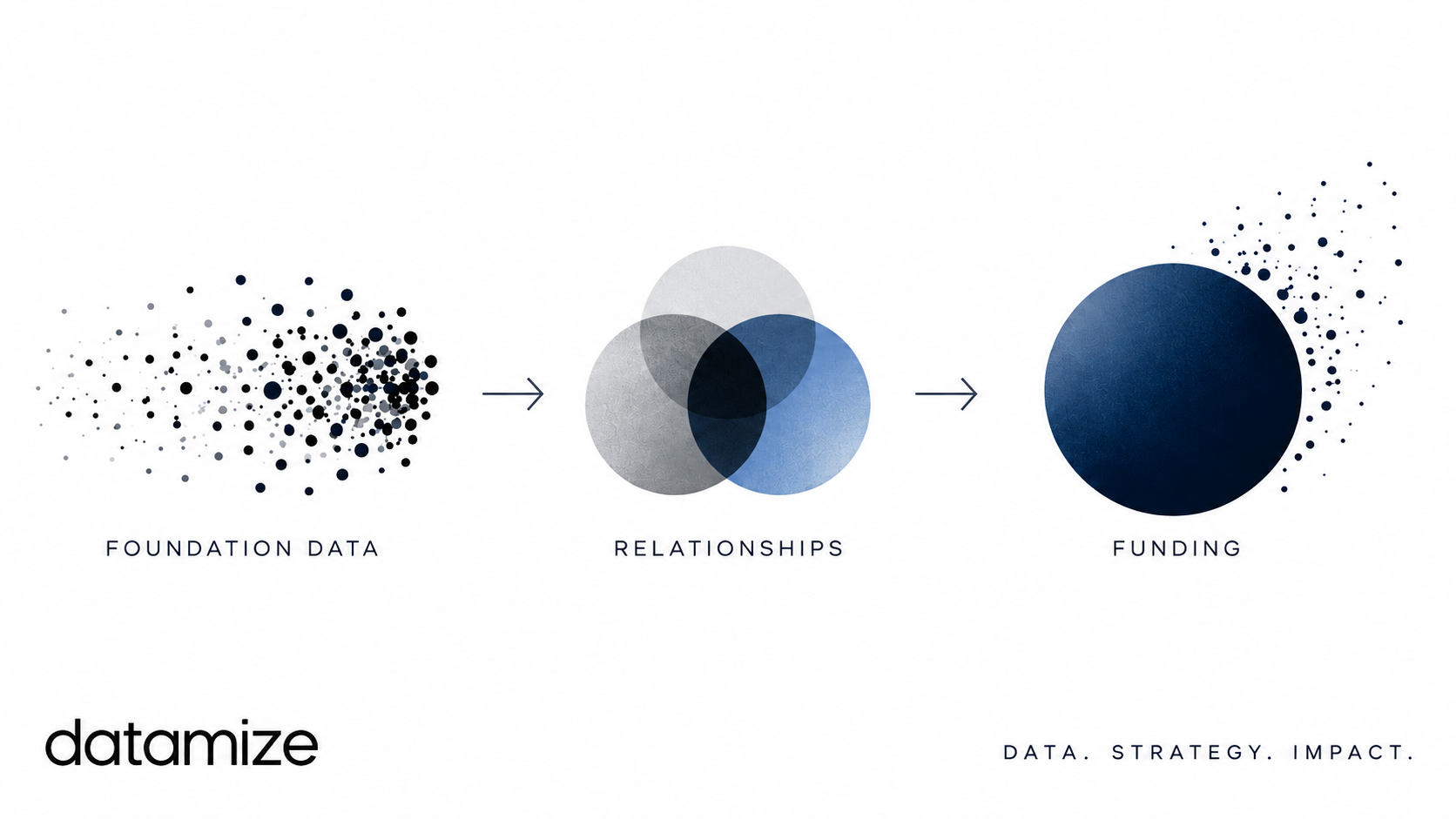
If your nonprofit wants to grow foundation funding, one of the first questions is often: Which foundation database should we use?
Candid Foundation Directory, Instrumentl, GrantStation, Grants.gov and other resources can help nonprofits identify funding opportunities. Some provide deep information about foundations and their historical giving. Others focus more on finding open opportunities, matching organizations with funders or managing the grant process.
So which one is best?
The answer depends less on which platform has the most data and more on what your organization needs to accomplish with that data. Before investing in another platform, there is an even more important question to answer:
Is finding foundations actually the problem?
It is easy to think of foundation databases as interchangeable, but different platforms are designed to solve different problems.
If your primary need is researching private foundations, their giving history, past grantees and funding interests, a research-focused platform such as Candid Foundation Directory may make sense. If you want to discover grant opportunities while also organizing prospecting, deadlines and grant activity, a platform such as Instrumentl may be a better fit.
GrantStation is another option for identifying potential funding opportunities, while Grants.gov should be part of the research process for organizations pursuing federal funding. There are also free resources, including IRS nonprofit data and ProPublica's Nonprofit Explorer, that can be valuable for reviewing Form 990 filings and researching foundations without immediately adding another paid subscription.
The question isn't simply “Which database is best?” It's “Which database is best for what we're trying to accomplish?”
Candid Foundation Directory is one of the best-known tools for researching foundations and institutional funders. Its strength is the depth of information available for understanding potential funders, including giving interests, past grants and historical grantees.
It can be particularly useful when your organization wants to conduct deeper prospect research rather than simply search for currently advertised grant opportunities. For nonprofits building a serious foundation prospecting program, understanding who a foundation has actually funded can be much more valuable than simply finding a foundation whose stated interests appear to match your mission.
Instrumentl combines funder discovery with tools designed to help nonprofits manage more of the grant process. That can make it attractive to organizations that want a platform to help identify opportunities, track prospects and deadlines, and manage grant activity in one place.
For a smaller development team without a well-established grant workflow, having research and workflow functionality together may be particularly useful. An organization primarily looking for deep foundation intelligence, however, may evaluate the platform differently from one primarily looking for grant discovery and workflow management.
GrantStation provides another way for nonprofits to identify potential funding opportunities from foundations, corporate giving programs and other sources. It may be a good fit for organizations that want a grant research resource without necessarily needing a larger prospect-intelligence or fundraising technology ecosystem.
As with any platform, the value depends heavily on how consistently the organization uses the information it finds.
For nonprofits pursuing federal grants, Grants.gov is an important resource. But federal grant prospecting is different from foundation prospecting. Federal opportunities often have highly specific eligibility requirements, application processes, compliance requirements and timelines.
Organizations should therefore think about government funding and private foundation fundraising as related but distinct strategies rather than expecting one directory to solve both.
Not every nonprofit needs to begin with an expensive subscription.
IRS Form 990 filings can reveal valuable information about a foundation's assets, officers, giving and grant history. ProPublica's Nonprofit Explorer makes much of this information easier to access and search. Foundation websites, annual reports, published grantee lists, LinkedIn and general web research can add another layer of intelligence.
For an organization making its first few foundation approaches, these resources may be enough to begin building a prospect list before investing in a more sophisticated platform. But as the number of prospects grows, the time required to manually research and organize all of this information grows with it. That's when technology can become increasingly valuable.
This is where the foundation database conversation often goes wrong.
A powerful database can give your organization hundreds or even thousands of potential funders. That doesn't mean your development team should pursue hundreds or thousands of foundations.
The objective isn't to build the biggest list. It's to identify the funders where your organization has the strongest opportunity for alignment and funding.
Imagine two organizations. One exports 500 foundation names from a database and begins sending generic outreach. The other identifies 40 highly relevant foundations, studies their giving history, determines why each might care about the organization's work, prioritizes them, develops an approach and consistently follows up.
The second organization may have the smaller database and the much stronger foundation fundraising program.
Finding prospects is only the beginning.
A productive foundation fundraising process looks more like:
Research → Qualification → Prioritization → Engagement → Relationship Building → LOI/Proposal → Follow-Up → Stewardship → Learning
A database primarily helps with the beginning of that process. The rest requires strategy, people, content, processes, data and consistent execution.
For every serious foundation prospect, your organization should be able to answer questions such as:
A list of foundation names doesn't answer those questions. A foundation fundraising system does.
Not every potential funder deserves the same amount of your team's time. A simple foundation-fit framework can help.
Mission Fit: How closely does the foundation's giving align with your mission?
Program Fit: Has it funded programs similar to the one for which you are seeking support?
Geographic Fit: Does it regularly fund organizations or programs in your service area?
Giving History: What does its actual grantmaking tell you about its priorities?
Grant Size: Are its typical grants appropriate for the amount you are seeking?
Accessibility: Does it accept applications or inquiries from organizations without an existing relationship?
Relationship Potential: Does anyone connected to your organization have a path to the foundation, its leadership or its network?
These factors can be used to rank prospects rather than treating every database result equally. A foundation with a perfect keyword match but no geographic alignment may deserve less attention than a foundation whose actual giving history demonstrates a strong connection to your work.
The goal is not more prospects. The goal is better prospects.
Identifying the right foundations is only part of the opportunity.
Foundations are made up of people. Those people research, evaluate and form opinions about the organizations they may fund. Once you identify a high-priority foundation, the next questions should be: Who are the people involved in funding decisions? What matters to them? What do they need to understand about your organization? And what will they experience when they encounter you?
A program officer may visit your website after receiving an introduction. A board member may see a post from your CEO on LinkedIn. A foundation executive may search for your organization or ask an AI tool about your work. Someone may attend an event, read an impact story, watch a program video or receive a briefing from a mutual connection.
Each interaction helps shape that person's understanding of your organization.
That means foundation development isn't only about creating a strong proposal. It is also about creating the content and experiences that make your organization easier to understand, trust and remember.
For your highest-priority foundation audiences, think about what they should encounter before, during and after direct outreach. That might include clear program pages, compelling impact stories, credible outcomes and data, leadership perspectives, relevant research, short videos, case studies, annual reports, personalized briefing materials or opportunities to experience the work firsthand.
The objective isn't to bombard foundation staff with marketing. It is to make sure that when the right person becomes interested in your organization, there is a consistent and compelling body of evidence supporting the relationship.
Don't just build a foundation prospect list. Build an experience around the people you most want to know your organization.
A stronger foundation strategy connects these activities rather than treating prospect research, communications and grant writing as separate functions.
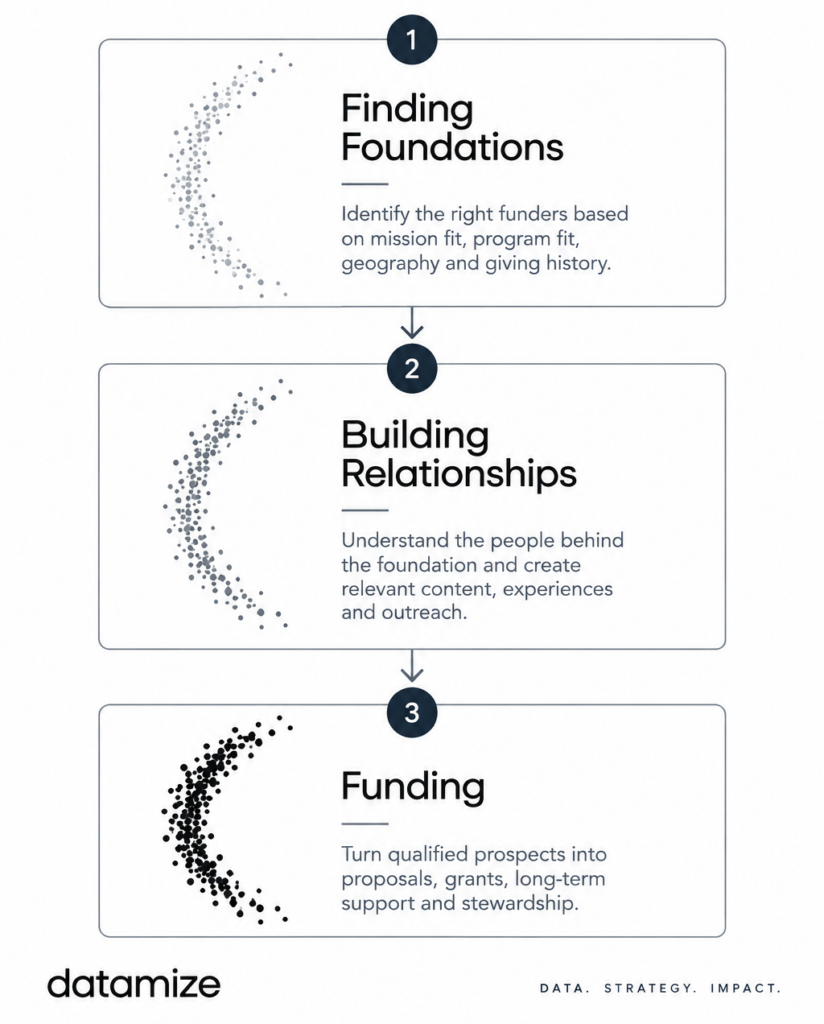
This is where foundation fundraising becomes much more than searching a database and submitting applications. The goal is to build a system that helps the right people discover your organization, understand its work, develop confidence in its impact and ultimately build a relationship with it.
For a high-value foundation prospect, consider the experience from that person's perspective:
Awareness → Discovery → Understanding → Trust → Engagement → Relationship → Funding → Stewardship
At each stage, ask what information or experience would help move the relationship forward.
During discovery, that may be a strong website and a clear explanation of the problem your organization solves. During understanding, it may be program information, outcomes, financial credibility and evidence of impact. During trust building, it may be leadership content, third-party validation, stories from the people you serve or a conversation with program leadership.
During engagement, it might be an invitation to visit a program, attend an event, participate in a briefing or meet the people doing the work. After funding, the experience matters just as much. Personalized updates, meaningful impact reporting and opportunities to see what their investment accomplished can help turn a grant into a long-term funding relationship.
The strongest foundation programs therefore don't simply maintain a list of prospects and deadlines. They deliberately build relationships, content and experiences around the people most important to their growth.
This is another common problem.
A nonprofit researches foundations and eventually creates an Excel spreadsheet containing hundreds of prospects. Someone updates it. Someone else creates another version. Applications are tracked in email. Deadlines live on calendars. Relationship notes live in someone's head. Award history is somewhere else.
Over time, valuable institutional knowledge becomes fragmented.
As a foundation fundraising program grows, qualified prospects should move into a structured system where the organization can track:
Foundation → Fit → Key People → Relationships → Program → Opportunity → Engagement → Next Action → Deadline → Stage → Requested Amount → Awarded Amount
Leadership should then be able to answer important questions quickly. How much foundation funding are we pursuing? How much have we requested? What is currently in the pipeline? Which prospects need follow-up? Which relationships are getting stronger? Which programs are attracting the most interest? What percentage of proposals are being funded? Which funders should we cultivate for larger or renewed support?
That is when foundation research begins becoming a repeatable growth system rather than a series of individual grant applications.
AI adds another layer to this process, but the opportunity isn't simply asking ChatGPT or another AI tool to write a grant proposal.
AI can help organizations turn large amounts of funder information into usable intelligence. An organization can combine information about a foundation's historical giving with its own programs, geography, funding needs, relationships and previous interactions to help evaluate fit, summarize research, compare prospects, identify patterns, prioritize opportunities, prepare briefing documents, develop relevant content ideas, personalize outreach, surface potential connections and recommend next actions.
A foundation database provides data. The bigger opportunity is turning that data into better decisions, stronger relationships and action.
Human judgment still matters enormously, particularly when evaluating fit, building relationships and developing compelling funding strategies. But AI can reduce the amount of time skilled fundraising professionals spend gathering and organizing information so they can spend more time developing relationships and securing support.
There isn't one answer for every nonprofit.
If you're just beginning foundation fundraising, start by defining your funding priorities, programs and ideal funder profile. Free research tools may be sufficient while you develop your process.
If you're actively building a larger foundation prospect pipeline, investing in a platform such as Candid Foundation Directory, Instrumentl or GrantStation may save significant research time and help uncover opportunities you would otherwise miss.
If you have an established institutional giving program, the bigger opportunity may no longer be finding another database. It may be connecting external funder intelligence with your CRM, historical fundraising results, relationships, content, digital experiences and internal data so your team can make better decisions about where to focus and how to engage.
Before purchasing any platform, ask:
Do we need more foundation data, or do we need a better system for turning foundation data into funding?
The answer may change what you invest in next.
The best database is the one that helps your organization find the right opportunities and then act on them.
Technology can make prospecting dramatically easier. But sustainable foundation growth still requires disciplined research, qualification, prioritization, relevant content and experiences, relationship building, strong proposals, consistent follow-up, stewardship and the ability to learn from results.
Datamize helps nonprofits connect those pieces. From foundation research and prospect prioritization to identifying key people, developing content and engagement strategies, managing the pipeline, improving data and technology, strengthening outreach and proposals, and supporting ongoing execution, we help organizations build a more systematic approach to growing institutional support.
Looking to grow foundation funding? Talk to Datamize about where the biggest opportunity is in your current foundation fundraising program.
 and then